Jay-Z on 2Pac and Biggie: How Their Fallout Became the East Coast-West Coast War
Friendship, betrayal, and the warning that changed everything

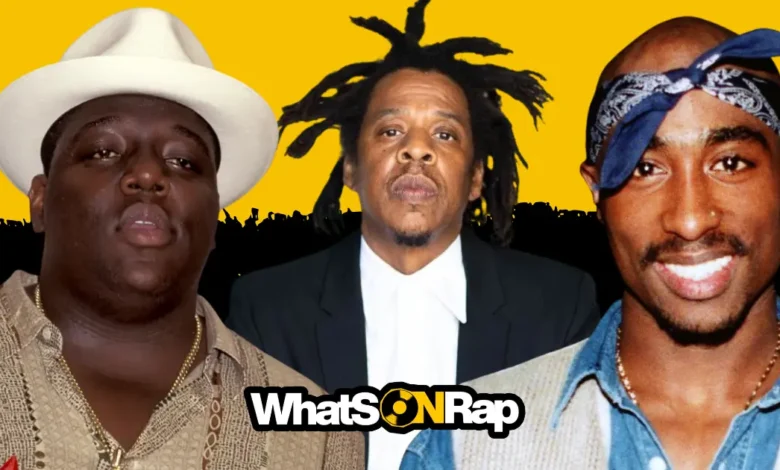
Jay-Z on 2Pac and Biggie has once again put the spotlight on one of the most tragic chapters in hip-hop history. In his new HBO Max docuseries JAŸ-Z in 8, the Brooklyn legend sat down with producer Rick Rubin and offered a clear, personal account of how two of the greatest rappers of all time went from close friends to symbols of a coast-to-coast war that ended in bloodshed. Jay-Z’s version does not rely on rumors or old magazine headlines. Instead, he walks listeners through the exact chain of events that turned a private disagreement into a public disaster.
The story begins long before the diss tracks and the media frenzy. Biggie and 2Pac were genuinely tight. They hung out, supported each other, and moved in the same circles during the early 1990s. According to Jay-Z, the crack in that friendship appeared when 2Pac’s fame exploded and a dangerous group of people started surrounding him. What happened next, combined with the 1994 Quad Studios shooting and the release of “Who Shot Ya?”, created a perfect storm. Jay-Z’s recent comments give fans a rare inside look at the human side of a conflict that still shapes how people talk about loyalty, pride, and consequence in hip-hop.
This article breaks down everything Jay-Z said in detail, places his words in the larger timeline of the East Coast-West Coast war, and examines why the fallout between two friends became bigger than both of them. From the original warning Biggie gave 2Pac to the moment the media turned a personal problem into a national war, the full picture is more complicated and more human than most people remember.
Table of Contents
Jay-Z on 2Pac and Biggie – The Warning That Started Everything
According to Jay-Z, the trouble did not begin with a diss record or a public slight. It began with a quiet conversation between friends. As 2Pac’s star rose, Biggie noticed a certain group of people getting closer to him. These were not casual associates. They were individuals Biggie knew from the New York streets and considered dangerous.
Jay-Z recalled the moment clearly: “Big tells 2Pac, ‘Yo, yo, watch those guys. I know those guys. They’re not good guys.’” The warning was meant as protection. Biggie was looking out for someone he considered a friend. What happened next changed the entire dynamic.
2Pac repeated Biggie’s warning to the same people Biggie had warned him about. That decision created immediate problems for Biggie back home in New York. The men who had been called out were now angry at Biggie for speaking against them. Jay-Z explained that Biggie suddenly found himself dealing with serious street figures who felt disrespected. The friendship that once felt solid now carried real risk for the Brooklyn rapper.
This part of the story is rarely told with such clarity. Many fans know the public version of the beef, but few have heard how a single warning, intended to protect 2Pac, ended up putting Biggie in a difficult position in his own city.
The Quad Studios Shooting and the Blame That Followed
Everything escalated in November 1994 at Quad Recording Studios in Manhattan. 2Pac was robbed and shot multiple times in the lobby of the building. He survived, but the physical and emotional impact was massive. At the time of the shooting, Biggie and other artists were upstairs in the same building recording. No one was ever charged in the attack, though later claims by Dexter Isaac pointed toward music manager James “Jimmy Henchman” Rosemond as the person who allegedly ordered the robbery.
Jay-Z’s account focuses on how 2Pac processed the trauma. In the docuseries he said: “I don’t know what was going on with 2Pac at the time. I don’t know if it was embarrassment or what he felt. He knew that Biggie told him and warned about these guys. He knew it was these guys, and he blamed Biggie.”
Instead of acknowledging the earlier warning, 2Pac framed the situation differently. Jay-Z described the shift: “So instead of saying, ‘This guy warned me about these guys,’ he turned it into a thing like, ‘This supposed to be your city. How this could happen to me in your city?’”
Jay-Z rejected that framing completely. He pointed out that no single artist, not even the biggest name in New York at the time, controlled the streets of the city. New York was too large and too full of independent players for any one person to guarantee safety. Biggie’s status as a rising star did not give him power over the people who had targeted 2Pac.
This misunderstanding, according to Jay-Z, became the emotional core of the conflict. 2Pac felt betrayed. Biggie felt wrongly accused. The personal bond that once existed between them was now broken.
“Who Shot Ya?” and the Point of No Return
While Biggie largely tried to stay out of the musical back-and-forth, one record became impossible to ignore. “Who Shot Ya?” was released and immediately interpreted by many as a response to the Quad Studios shooting. Jay-Z acknowledged that the song added fuel to an already burning fire.
He noted that Biggie was a great rapper and a good person, but the timing and the title of the track made it easy for people to read it as a direct message. Whether or not Biggie intended it that way, the perception stuck. From that moment, the private disagreement between two friends began to look like an open war.
Jay-Z also shared a smaller but revealing detail about his own collaboration with Biggie. When they recorded “Brooklyn’s Finest” for Reasonable Doubt, Biggie originally had a line that read “Most hated in California.” Jay-Z asked him to remove it. He did not want to get pulled into the growing coastal tension. The half-bar was cut, leaving a noticeable gap in the verse that careful listeners can still hear today.
How the Media and Outside Voices Turned a Personal Conflict Into a War
One of the most important points Jay-Z made is that the conflict between 2Pac and Biggie did not stay between 2Pac and Biggie. Once magazines and television shows began covering the tension, the story grew far beyond the original disagreement.
“It took on a life of its own,” Jay-Z said. Magazines started running stories. People who had nothing to do with the original warning or the Quad Studios shooting suddenly found themselves involved. Fans on both coasts began choosing sides. The personal fallout became a symbolic battle between New York and Los Angeles.
This expansion is what turned a friendship-ending misunderstanding into the East Coast-West Coast war that still defines an entire era of hip-hop. Artists who were never part of the original circle felt pressure to pick a side. The stakes rose from personal pride to something far more dangerous.
Jay-Z’s comments in JAŸ-Z in 8 line up with accounts from other people who were close to both artists. Ed Lover has spoken about how tight Biggie and 2Pac once were and how painful it was to watch the relationship collapse. Lil’ Cease has described Biggie’s confusion and hurt when the accusations began. These earlier testimonies support the idea that the public version of the beef was louder and more simplified than the private reality.
The Larger Context of the East Coast-West Coast Rivalry
The conflict between 2Pac and Biggie did not happen in a vacuum. By the mid-1990s, Death Row Records and Bad Boy Records were already competing for dominance. Suge Knight and Sean “Diddy” Combs represented two different approaches to power and image. The personal tension between their biggest stars became the most visible symbol of that larger competition.
After 2Pac was released from prison in 1995 and signed with Death Row, the disses became more frequent and more personal. Tracks like “Hit ’Em Up” left little room for interpretation. On the other side, the New York camp largely tried to stay quieter, but the damage was already done. Both artists were murdered within six months of each other in 1996 and 1997. Neither case has been fully resolved in the public eye, though recent legal developments around Duane “Keffe D” Davis have brought new attention to 2Pac’s killing.
Jay-Z’s recent comments do not claim to solve those murders. They do, however, offer a clearer picture of how the emotional and personal foundation of the conflict was laid years earlier. By focusing on the warning, the shooting, and the way blame was assigned, he gives listeners a more human timeline than the usual “East vs West” narrative.
Why Jay-Z’s Account Matters Now
More than two decades later, the story of 2Pac and Biggie still generates discussion, documentaries, and debate. New generations discover their music every year and eventually ask the same questions: How did two friends end up on opposite sides of a war? Why did it escalate so quickly? Could it have been stopped?
Jay-Z’s version does not pretend to have every answer. What it does provide is a firsthand perspective from someone who was close to Biggie and who watched the situation unfold in real time. His insistence that Biggie tried to warn 2Pac, and that 2Pac knew the warning was about the same people involved in the shooting, adds a layer of tragedy that pure “beef” narratives often miss.
The fallout between 2Pac and Biggie remains one of the clearest examples of how personal loyalty, street politics, pride, and media amplification can combine with deadly results. Jay-Z’s recent comments remind us that behind the myth and the music were two young men who once considered each other friends—and whose inability to bridge a single misunderstanding helped shape an entire era of hip-hop history.